
How much does driving without a vignette cost in 2026?
The most common situation is €150. A camera reads the license plate, and the district office (okresný úrad) issues an order to impose a fine (rozkaz o uložení pokuty) for this amount without any prior proceedings. The envelope also contains photos of the violation and the control record. A discount is also written in the law: if two-thirds of the amount arrives in the account within 15 days of delivery, the fine is considered fully paid. That is, €100 instead of €150. And if you are stopped directly on the road, a different logic and different numbers apply – the upper limit there is €500.
| Situation | Who decides | Amount |
|---|---|---|
| Order from a camera to the car owner (správny delikt - administrative offense) | district office | €150, or €100 if paid within 15 days |
| The same, but settled on the spot by block order | Police of the Slovak Republic | €100 (two-thirds of €150) |
| Proceedings against the driver as a violator (priestupok - misdemeanor) | district office | €100–€500 |
| Driver's violation, settled by block order on the spot | Police of the Slovak Republic | €50–€200 |
| Objection filed and lost — proceedings costs | district office | additional €30 |
All amounts in the table are from the text of the law on vignettes, paragraphs 10, 10a, 11, and 15.
Control is not carried out only by cameras. The check is carried out by the toll administrator — Národná diaľničná spoločnosť (NDS) — in cooperation with the police, and the collected data goes to the Ministry of Transport and district offices. In July 2026, road workers, together with the Bratislava regional inspectorate, checked almost 5300 drivers in one weekend and issued about 60 fines; the most violations were recorded at the Jarovce — Kittsee crossing. Checks were announced for the entire summer.
Another detail in your favor. Proceedings against the driver and against the car owner cannot run in parallel for the same violation in the same calendar month, and several entries onto toll sections by one car within a month are settled by one order. Other road sanctions are counted on a different scale — we have a separate breakdown of fines about them.
A fine arrived, but you bought a vignette. What to do?
First, find the Potvrdenie o úhrade — proof of payment, which arrives by mail, and by SMS if you provided your phone number. This, not a bank statement, is proof of purchase. Check the license plate symbol by symbol and the start date of validity. According to NDS data, the most common reason for an "unexplained" order is a typo in the evidenčné číslo vozidla (license plate) or a payment that did not go through the bank. If confirmation never arrived, and you provided the correct address, you do not have a valid vignette, even though the money was debited.
Here is the procedure if you are sure the order is incorrect:
- Check the vignette's validity in the "Kontrola platnosti diaľničnej známky" section on the eznamka.sk portal — by license plate and country of registration.
- Submit an odpor (objection) to the same district office that issued the order. The deadline is 15 days from the date of delivery.
- Justify it. The law requires you to state specific circumstances and attach evidence immediately; a scan of the payment confirmation is usually sufficient.
- Calculate the risk. If the fine is still imposed after the objection, €30 in proceedings costs will be added.
There are situations where a case is postponed without your involvement: the car or license plates were reported stolen at the time of the violation, the vehicle is exempt, or the owner has already been fined for the same offense within the previous 12 months, paid it, and subsequently purchased a vignette. In most of these cases, a decision is not even issued, and the owner is not notified.
Will a fine catch up after leaving Slovakia?
The state has enough time: a penalty can be imposed within two years from the date of the violation. The order is sent to the address of the vehicle owner (prevádzkovateľ vozidla), not the driver. For cars registered in EU and European Economic Area countries, the law adds a guarantee: the rozkaz is also sent in one of the official languages of the country of registration along with an information form about the nature of the offense, and if it cannot be delivered after a second attempt, the document is considered undelivered.
There is no such separate provision in the law for Ukrainian license plates: it specifically refers to EU and EEA member states. The practical conclusion is simple. No one should count on "they won't find me," especially those living in Slovakia and keeping their car at their home address.
Separately about being stopped on the road. If the violation cannot be settled on the spot by block order, the police officer has the right to require the driver to pay a cash deposit equal to the fine. The deposit is forfeited to the state if the driver does not present reliable documents with the owner's details.
Do you need a vignette on your route?
Not everywhere. The official list of toll sections includes 24 items, and outside of these, there are over 200 km of highways and expressways that can be driven without any payment. The state's logic is simple: bypasses around major cities have been made free to prevent transit and local traffic from entering the center. Therefore, a resident of Bratislava or Košice can drive for years without buying a vignette — and without violating any rules. But the border between toll and free sections is not between cities, but between specific interchanges, so you need to look at those.
| City | What is free | Where the toll begins |
|---|---|---|
| Bratislava | D4 from Rača to the interchange with D2 near Jarovce (27 km), D2 Stupava — Jarovce (22 km), D1 Bratislava-Pečňa — D1/D4 interchange (16 km), R7 Bratislava-Nivy — Ketelec (7 km) | D1 from the D1/D4 interchange towards Senec, D4 near the Jarovce/Kittsee crossing (2 km), D2 Čunovo — Jarovce (9 km), R7 further towards Šamorín and Holice (25 km) |
| Prešov | D1 Prešov-Západ — Prešov-Juh (7 km), R4 Prešov-Sever — Prešov-Západ (5 km) | D1 Spišský Štvrtok — Prešov-Západ (60 km), D1 Prešov-Juh — Košice-Sever (20 km) |
| Košice | D1 Košice-Sever — Rozhanovce (6 km), R4 Rozhanovce — Košice-Šebastovce (6 km), R4 Košické Oľšany — Rozhanovce (15 km) | D1 Rozhanovce — Bidovce (8 km), R4 Košice-Šebastovce — Milhosť (14 km) |
| Poprad | D1 Poprad-Západ — Poprad-Východ (6 km) and further to Jánovce (12 km) | D1 Ivachnová — Poprad-Západ (64 km) |
| Žilina | D1 Hričovské Podhradie — Lietavská Lúčka (12 km), D3 Hričovské Podhradie — Žilina-Brodno (13 km) | D1 Bratislava-Východ — Hričovské Podhradie (172 km), D1 Lietavská Lúčka — Turany (31 km) |
| Nitra | R1 Nitra-Západ — Nitra-Východ (12 km), R1A Nitra-Západ — Nitra-Dražovce (5 km) | R1 Dolná Streda — Nitra-Západ (23 km), R1 Nitra-Východ — Hronská Breznica (86 km) |
| Banská Bystrica | R1 Banská Bystrica-Kremnička — Banská Bystrica-Východ (11 km) | R1 Hronská Dúbrava — Banská Bystrica-Kremnička (20 km) |
The sign that decides everything is small and blue. Under the green highway sign, there is a square with the inscription e-známka / e-Vignette and a euro symbol. Crossed out with a red stripe — a section without a toll. Not crossed out — a vignette is required further on. NDS keeps a complete list of free sections with mileage on its website next to the map.
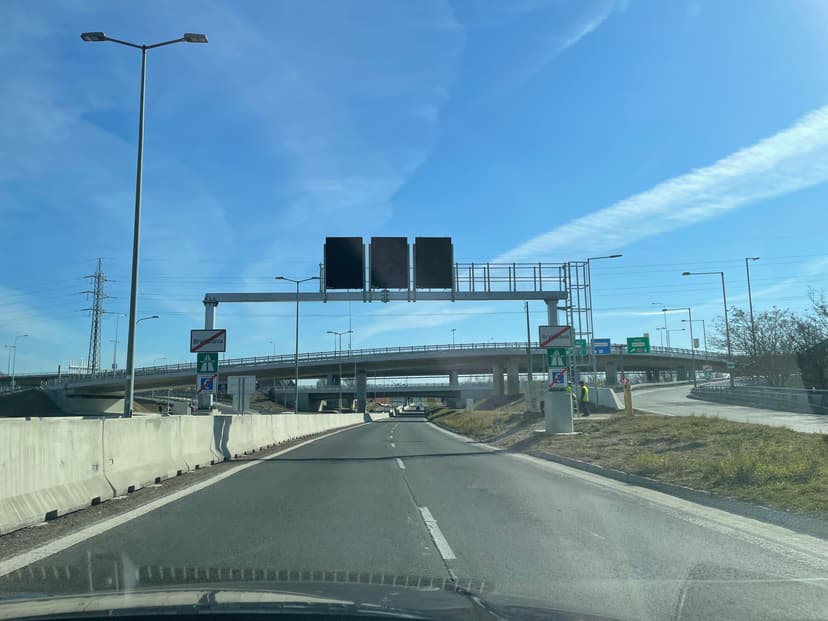
Bratislava has become even freer since July 2026. After the opening of all eight branches of the D1/D4 interchange on June 21, 2026, the entire outer bypass D4 is free for passenger cars; this does not apply to trucks, which pay tolls according to general rules. The D1 in the Bratislava region is tolled only from the D1/D4 interchange towards Senec and back. And the two kilometers of D4 near the Jarovce/Kittsee crossing and a few kilometers of D2 between Čunovo and the interchange with D4 are tolled, so a trip "shopping in Austria" still requires a vignette.
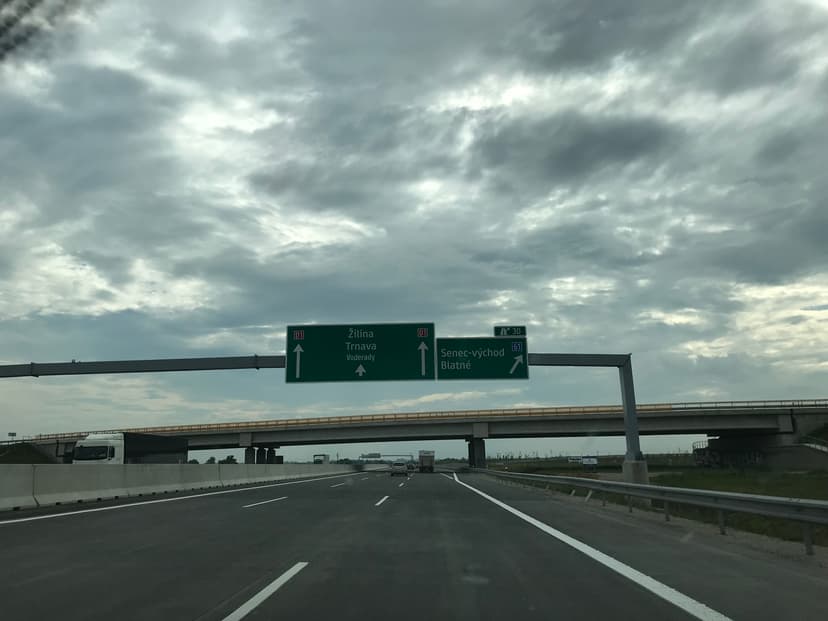
There is a third category — sections that are formally on the list of toll roads but are temporarily excluded from payment (marked Dočasne vyňatý úsek - temporarily excluded section). Currently, these are D2 Brodské — Kúty on the Czech border, D1 Poprad-Východ — Spišský Štvrtok, and two kilometers of R1 Sládkovičovo — Dolná Streda. The status is temporary, so it's worth updating the map before a long trip. We wrote about other rules on Slovak roads — speed, parking, mandatory equipment — in a separate article.
How much does a vignette cost in 2026 and where to buy it?
There are four tariffs, and the calendar "annual" vignette no longer exists in the Slovak system — its role is performed by a 365-day vignette, which is calculated from your chosen day. Prices are set by government decree, are the same for all vehicles up to 3.5 tons, and do not depend on the number of trips.
| Vignette type | Price 2026 | How the period is calculated |
|---|---|---|
| 1 day | €8.10 | until 23:59:59 of the chosen day |
| 10 days | €10.80 | 10 days including the chosen one |
| 30 days | €17.10 | 30 days including the chosen one |
| 365 days | €90 | 365 days including the chosen one |
| Trailer O1/O2, only if the total weight exceeds 3.5 tons | the same four tariffs | the same |
There are three things to know about the validity periods. The start date can be set to the day of payment or any later day, but no more than 60 days in advance. A 30-day or 10-day vignette purchased in December will easily last its term in January. It's best to enter the expiration date in your calendar right away — this way you won't depend on notifications.
The only official online sales channel is the eznamka.sk portal and the eZnamka app, which recently added Google Pay and Apple Pay. Offline sales are at gas stations, information and sales points at border crossings, and selected Slovak Post offices in regional cities. Intermediary websites charge an additional commission: according to NDS calculations, in 2025, drivers overpaid them more than €4.5 million without any added value, and some "portals" do not process the vignette at all. If you are just learning about the system, start with a basic explanation where we explained the mechanics of the electronic vignette, and always check the current tariffs on the official website.
Trailer, van, motorcycle, or electric car — which system applies?
This is where most mistakes happen. Vignettes are paid by two-axle vehicles and trailers up to 3.5 tons, as well as all passenger car categories M1 – regardless of weight. This means a large SUV or minivan registered as M1 and weighing over 3.5 tons pays a vignette, not a toll. Everything over 3.5 tons that does not belong to category M1 goes into the electronic toll system with an on-board unit.
| Vehicle | What is needed |
|---|---|
| Passenger car M1 of any weight | one vignette per car |
| Van N1 up to 3.5 tons | one vignette per car |
| Vehicle with a trailer, trailer up to 3.5 tons | one vignette, only for the towing vehicle |
| Car M1 or N1 with trailer O1/O2 over 3.5 tons | two vignettes: one for the car and one for the trailer |
| Truck or bus over 3.5 tons, not M1 | not a vignette, but mýto (toll) with an on-board unit |
| Motorcycle, tricycle | nothing: the law only applies to two-axle M1 and N1 vehicles |
| Electric car, hybrid | vignette under general conditions |
Exemptions from payment are listed in the law: vehicles of the Ministry of Interior and police, armed forces, integrated rescue system basic services, municipal police, Red Cross, historic vehicles, vehicles for social services, and transport registered to the holder of a parking card ŤZP (person with severe disability). Electric cars are not on this list – the system does not offer any discounts for being environmentally friendly. And most importantly: most exemptions do not work automatically; the vehicle must be registered in the NDS system and confirmed.
For trucks and buses over 3.5 tons, there is a separate toll law No. 474/2013. The rate is calculated based on the type of road, vehicle category, CO₂ and EURO emission classes, and the number of axles. Violations are handled by the district office where the carrier is registered. Motorcycles do not need a vignette at all, but there is a detail: on the highway, drivers must drive at a minimum speed of 80 km/h (§ 35 of law 8/2009), and only vehicles with a design speed of 60 km/h or more are allowed on roads for motor vehicles (§ 37 of the same law). If you have just cleared a Ukrainian car through customs and are registering it in Slovakia, you will need to re-register the vignette link along with the new license plates – we have described the process in our step-by-step guide.
Made a mistake when buying – what can still be corrected?
The buyer is fully responsible for the data entered, so the window for corrections is small. The procedure is as follows:
- At the point of sale – 15 minutes from payment. The seller corrects it on the spot.
- Online – do it yourself in your account on eznamka.sk: until the end of the calendar day of payment or until the day the vignette becomes valid.
- Later – only by submitting an application through the "Žiadosti, podnety a reklamácie" (Requests, suggestions, and complaints) section. You will need the Potvrdenie o úhrade (Proof of payment; bank statement is not accepted), the vehicle registration certificate, and a certificate from the competent authority stating that such a license plate does not exist.
- A one-day vignette cannot be corrected this way: NDS recommends buying the correct one and canceling the incorrect one to get a refund.
There are two limitations, and they are rarely mentioned: you can correct a maximum of half the characters of the license plate, and an expired vignette cannot be corrected at all. The start date can also only be changed before it has passed. Not retroactively.
Money is refunded in four cases: double payment for the same vehicle with overlapping validity periods, payment for a vehicle that is not subject to vignettes at all, payment for an already exempt vehicle, and payment for a non-existent license plate – the last case only if the error was corrected and the correct vignette was purchased for the same vehicle. "Did not use" is not a valid reason – it is payment for road access, not a product on a shelf. You can cancel a purchase without giving a reason before the start of the validity day or within 15 minutes of payment if you paid on the start day itself.
Changing the license plate is a separate issue. Vignettes are not transferable between different vehicles, but they are transferable by license plate: if you re-register the same vehicle or your plates were replaced after theft, submit a Žiadosť o zmenu (Application for change) with the old and new registration certificates and proof of payment. When changing from a Slovak plate, written consent from the previous owner is also required. If you sell the car with the license plates, you will not get a refund for the vignette – it is simply included in the price.
What to check before you leave
Open a map of toll sections and see if your usual route is even subject to tolls: in Bratislava, Košice, Prešov, or Nitra, there's a good chance it's not. If you need a vignette, buy it only on eznamka.sk, in the app, or at a gas station. Immediately after payment, open the confirmation and check the license plate letter by letter. If you notice a mistake the same day, you can correct it yourself in a minute. If you notice it a week later, you will receive it along with a fine of €150.