
Sorting waste in Slovakia is not just a suggestion, but a legal duty for every resident of the country. The legal basis is the Act No. 79/2015 on waste, which regulates the handling of municipal waste and has been updated several times according to European Union directives. The last significant amendment came into force on January 1, 2025 — from now on, textiles and clothing are also subject to mandatory separate collection.
The law obliges municipalities to organize separate waste collection, and residents to follow the established sorting procedure. Everyone is responsible for proper waste management: both homeowners and tenants. An important feature of the Slovak system is that specific rules can vary depending on the city or municipality. Each municipality adopts its own generally binding decree (VZN) on the handling of municipal waste.
For example, in Bratislava, there is no separate container for metal — it is disposed of together with plastic, while in other cities there may be a special red container for metal waste. Therefore, the first step after moving should be to learn the rules of your specific city.
The waste collection system in apartment buildings is organized through common collection points with containers, which are accessible to all residents. In private houses, there are usually individual bins with fixed collection days.
Container colors in Slovakia: what to throw where
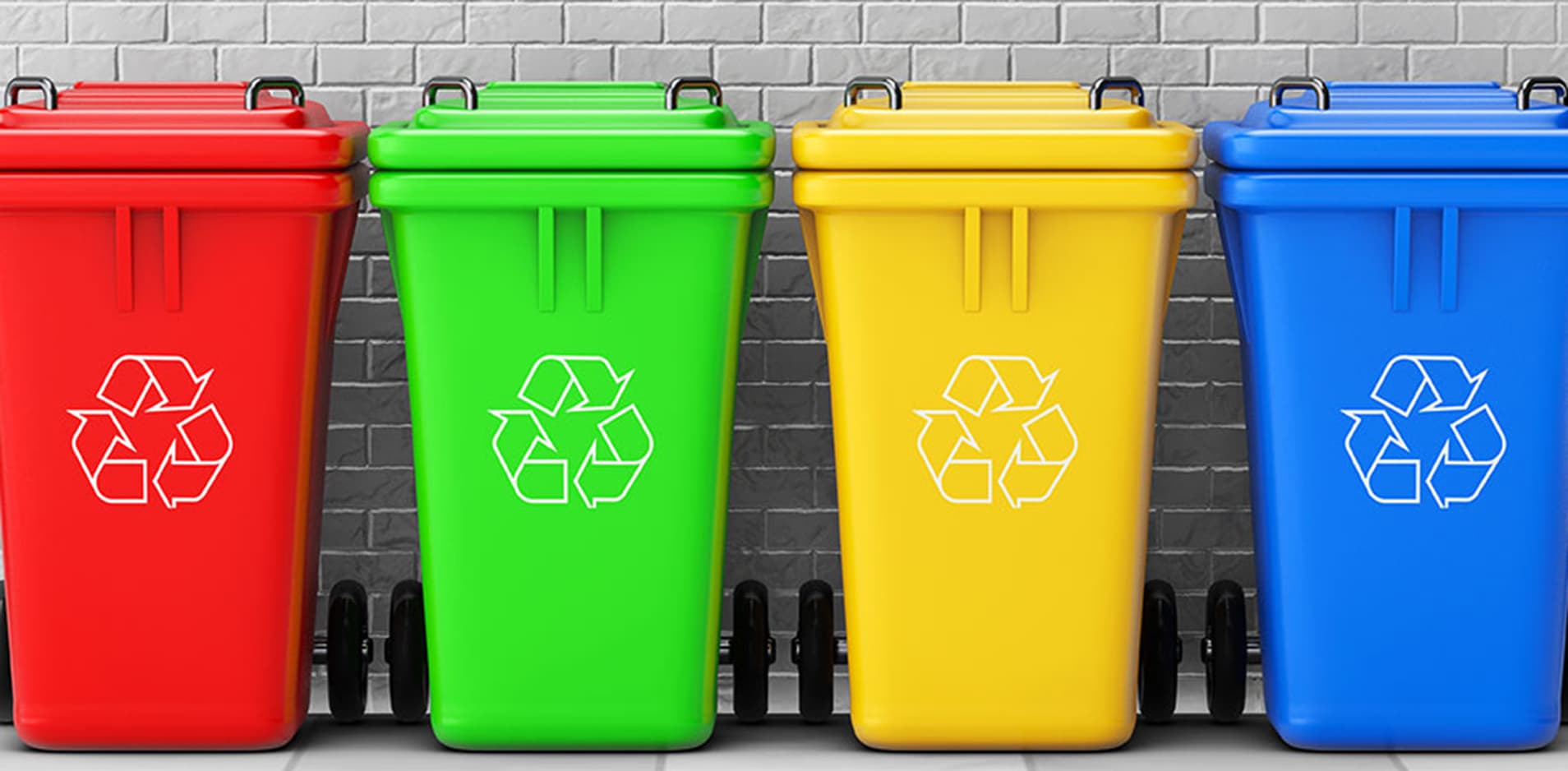
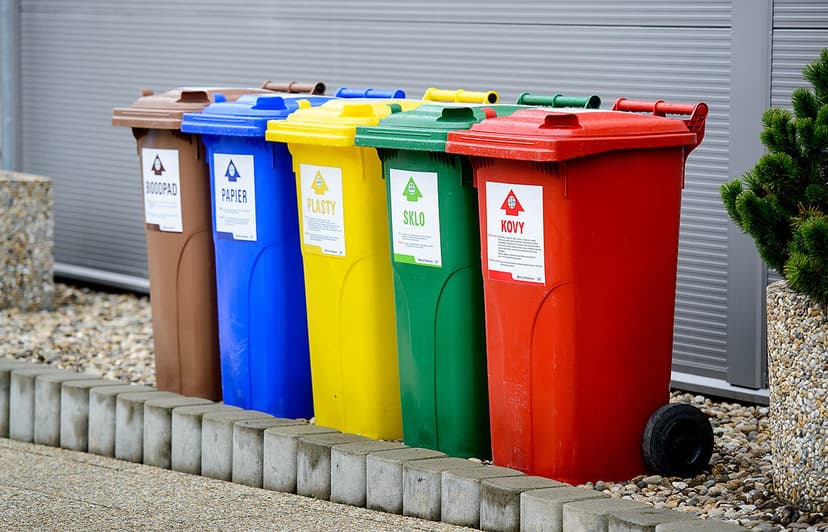
The system of color-coded containers is the main practical tool for sorting. Once you memorize the colors, understanding the process becomes much easier.
Blue container — paper
Throw into the blue container:
newspapers;
magazines;
catalogs;
office paper;
cardboard boxes (folded and flattened);
paper bags.
Before throwing away cardboard boxes, they should be folded to reduce their volume.
Do not throw into the blue container: wet, dirty, or greasy paper, napkins and paper towels, receipts (thermal paper), laminated paper, cartons from milk or juices — Tetra Paks (they go with plastic). Dirty paper, especially the greasy part of a pizza box, belongs to mixed waste.
Yellow container — plastic
The yellow container is for plastic:
plastic bottles (PET);
bottles from hygiene products and household chemicals;
plastic caps and lids;
metal cans (food cans, drink cans);
aluminum foil;
Tetra Pak packaging (multi-layered with cardboard, polyethylene, and aluminum).
Packaging should be thrown away empty — without residue. It is advisable to flatten bottles and cans to take up less space in the container. Do not throw here plastic with food residue, plastic bags with unsorted waste, or items made of multiple materials that cannot be separated.
Red container — metal
Metal packaging goes into the red bin, which will be recycled:
drink cans;
food cans;
metal lids from glass jars and bottles;
aluminum foil (clean and crumpled into a ball).
Do not throw: metal objects contaminated with hazardous substances (paint, varnish, or chemical residues), pressurized cans (deodorants, hairsprays), or electronics or cables. There are special collection points for such waste.
Green container — glass
The green container is exclusively for glass:
glass bottles;
jars;
glass tableware.
Glass does not need to be washed until it shines, it is enough for it to be empty. In some cities, there are two containers for glass — for clear and colored. If there is no such division, all glass goes into one bin.
Do not throw into the green container: light bulbs and fluorescent tubes (they are taken to special collection points), mirrors, window glass, porcelain and ceramics, as well as broken glass — it is dangerous and must be wrapped and placed in mixed waste.
Brown container — bio-waste
If your city or building has a brown container, it is intended for organic and food waste:
vegetable and fruit scraps;
coffee grounds and tea bags;
egg shells;
mowed grass and leaves.
Do not throw here: meat and fish, dairy products, processed food waste, or any plastic bags (even those marked as biodegradable, unless the municipality allows otherwise). The availability of a brown container depends on the specific municipality.
Black container — mixed waste
The black (or sometimes dark gray) container is for everything that cannot be sorted into other categories:
food scraps (if there is no brown container);
dirty paper and napkins;
chip bags;
small items made of mixed materials.
It is important to understand: the black container is not a "catch-all bin," but a place for truly unsorted waste. The less that goes into the black container, the lower the waste disposal fee in some cities.
Special containers and collection points
Separate disposal methods are provided for certain types of waste. Batteries and accumulators are accepted in special containers in supermarkets and pharmacies. Electronic devices (phones, computers, small appliances) cannot be thrown into regular containers — they are taken to special collection points for electronic waste (elektrozber). Expired medications are returned to the pharmacy. Paints, varnishes, and hazardous chemicals are collected during special events organized by the municipality, which are announced in advance to residents. Bulky waste (furniture, mattresses) is collected by separate request or on designated collection days. From January 1, 2025, clothing and textiles are also subject to separate disposal — they are taken to mobile collection points or special textile containers.
Sorting rules in apartment buildings
In apartment buildings, the containers are shared by all residents. This means that incorrect sorting by one family can affect all neighbors: if the contents of a colored container are found to be contaminated with unsorted waste, the entire batch may be sent to a landfill as mixed waste.
The building manager or homeowners' association (správca budovy) is responsible for the availability and condition of the containers. Residents, in turn, are obliged to follow the rules established by both national legislation and the internal rules of the building.
The same requirements apply to tenants as to owners: ignorance of the rules does not exempt from responsibility. Therefore, before moving into a new apartment, it is worth clarifying with the owner or management company where the containers are located, what their collection schedule is, and if there are any special rules for the building.
The frequency of waste collection depends on the type of container and the specific city. Mixed waste is usually collected weekly or every two weeks. Sorted fractions — paper, plastic, glass — are usually collected less often, once every two to four weeks. The exact schedule can be found on the municipality's website or on the container itself.
Fines for incorrect waste sorting
Slovakia is not a country with extremely strict fines for incorrect sorting at the household level — unlike, for example, Switzerland. However, this does not mean that violations go without consequences.
The Waste Act and municipal decrees provide for several types of sanctions.
At the first stage, the offender is usually issued a warning. In case of systematic violations, the municipality has the right to refuse to collect the contaminated container or to charge for exceeding the capacity of the mixed waste collection system. Fines can be imposed by the municipal inspectorate or the Slovak Environmental Inspectorate (Slovenská inšpekcia životného prostredia), but they are rarely applied at the individual household level and mostly only in cases of obvious systematic violations.
An important financial incentive is the payment system based on the actual amount of mixed waste, which is used by about 10% of Slovak municipalities. In such cities, the less unsorted waste a household produces, the lower the fee it pays. This means that correct sorting directly affects your wallet.
For foreigners who have just moved in, it is important to know: a one-time mistake at the beginning will not cause serious problems. However, conscious disregard of the rules or systematic contamination of inappropriate containers can lead to conflicts with neighbors, the management company, and ultimately — to administrative penalties.
Common mistakes made by foreigners
Most sorting difficulties for foreigners are not due to conscious disregard of the rules, but to a lack of knowledge of local specifics. Here are the most common mistakes:
Incorrect sorting of plastic and composite packaging. Tetra Pak (milk and juice cartons) goes with plastic, not paper. Dirty plastic with food residue goes into mixed waste, not the yellow container.
Throwing electronics into regular containers. An old phone, charger, or small appliance should never be put into household containers — this is a violation of the law.
Ignoring the local rules of a specific city. What worked in a previous city may not comply with the rules of a new municipality. Always check local regulations.
Using containers outside your place of residence. Throwing waste into the containers of someone else's building or street is prohibited — you are obliged to use the containers assigned to your address.
Not cleaning packaging. Packaging does not need to be washed until it shines, but obvious food or liquid residue should be removed, otherwise the entire batch may be deemed unsuitable for recycling.
Throwing hazardous waste into household containers. Batteries, medicines, paints, chemicals — none of these can go into regular containers.
How to find sorting rules in your city
Since sorting rules can vary significantly depending on the municipality, it is important to find the current information for your specific city. Here's where to look:
Municipality website (e.g., presov.sk, kosice.sk, etc.) — most cities publish detailed instructions and waste collection schedules in the section on the environment or municipal services.
Information leaflets from management companies — usually posted on bulletin boards in entrances or distributed upon moving in.
Contact information for municipal services — the hotline of the municipality or the waste collection company (OLO in Bratislava, Brantner, Kosit, etc.).
Websites of waste recycling operators: NATUR-PACK, ENVI-PAK — they provide clear explanations on sorting specific types of packaging.
QR codes on containers — many towns and cities have put QR codes on containers that lead directly to current instructions.
Sorting waste in Slovakia is a required part of daily life, and knowing the rules helps avoid fines and adapt faster. The system of colored containers is simple and logical — it is worth understanding the main fractions once, and the process will become usual. The first step is to learn the rules of your specific town and pay attention to the labels on the containers near your home.