
What is vyúčtovanie in Slovakia
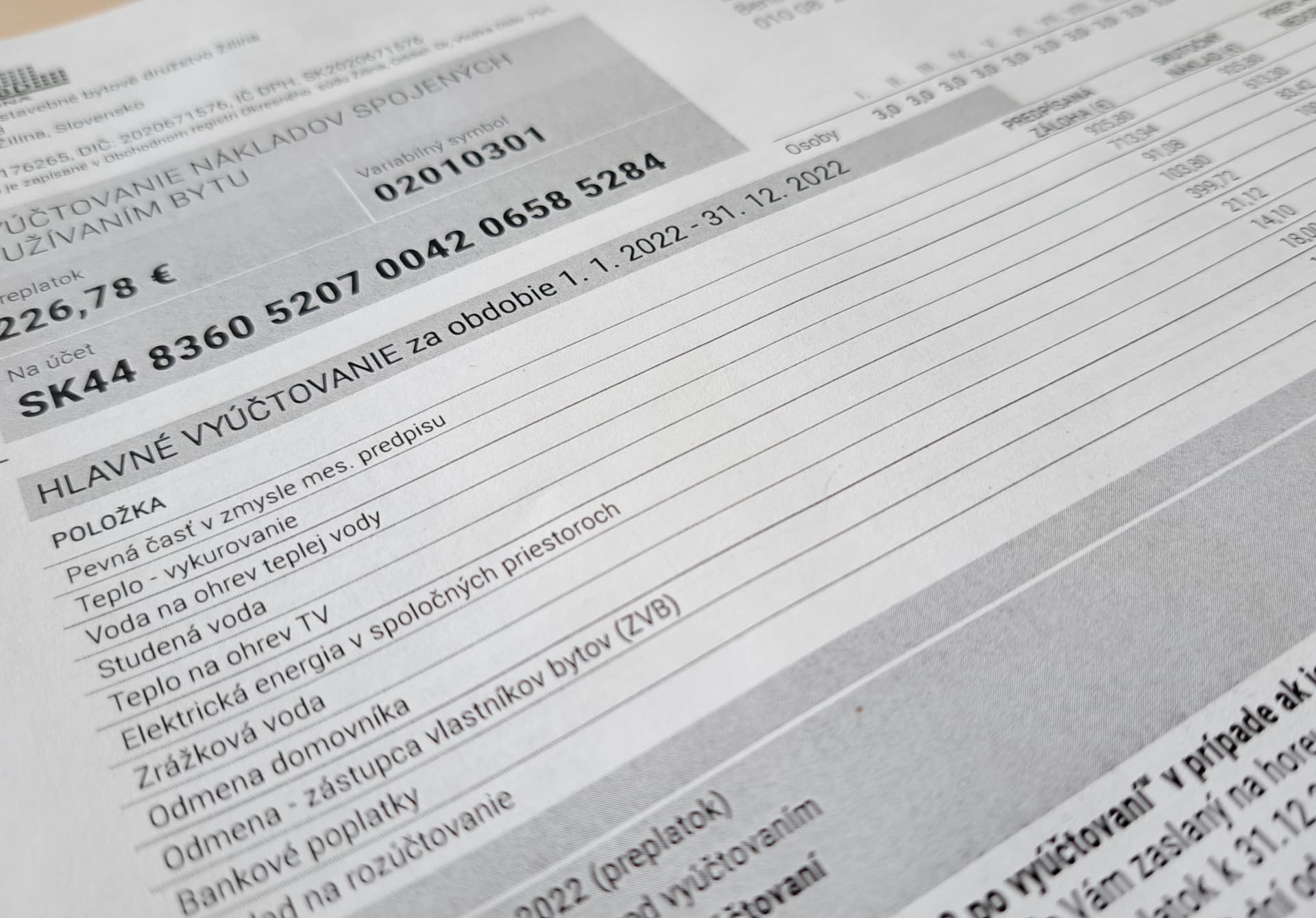
Vyúčtovanie is an annual reconciliation of utility services and costs related to living. Simply put, it is a final document that compares how much you paid in advance (zálohové platby) during the year with how much you actually consumed. The result can be either an overpayment (preplatok) — in which case you get money back, or an underpayment (nedoplatok) — in which case you need to pay more.
The Slovak system of utility payments is based on advances. Every month, a resident pays a fixed amount — zálohová platba — which is only a preliminary estimate of future costs based on previous consumption or average figures. Actual consumption is calculated only at the end of the billing year, after meter readings are taken. This is when the vyúčtovanie is created.
What services are included in the reconciliation
A standard vyúčtovanie may include the following types of services:
Teplo (heat) — central heating of an apartment or house. One of the most expensive items.
Teplá voda (hot water) — heating water through the central system.
Vodné a stočné (cold water and sewage) — water supply and wastewater disposal.
Plyn (gas) — if there is a separate meter or an individual gas system.
Elektrina (electricity) — in apartments with individual meters.
Správa budovy (building management) — cleaning of stairwells, elevator maintenance, building insurance, waste disposal, upkeep of common areas, etc.
Who performs the reconciliation
Depending on the type of your housing, the reconciliation may be performed by:
Správcovská spoločnosť (management company) — the most common option for tenants in regular apartment buildings. This company is responsible for consumption accounting and creating the document.
Spoločenstvo vlastníkov bytov (SVB, association of apartment owners) — if the building is managed by the owners themselves.
Prenajímateľ (landlord) — if you rent an apartment from a private person, they receive the vyúčtovanie from the suppliers and settle with you.
Dodávateľ energií (energy supplier) — SPP (gas), ZSE Energia, VSE, SSE (electricity) send their own annual bills directly.
When vyúčtovanie arrives
The deadlines depend on the type of service:
Heat and hot water. According to Act 182/1993 Coll. on ownership of apartments and non-residential premises, vyúčtovanie is issued annually and must be delivered to apartment owners by May 31 of the following year. This means that for 2024, it should arrive no later than May 31, 2025.
Gas. SPP traditionally sends vyúčtovanie in the second half of February. ZSE Energia and Innogy — at the end of February or the beginning of March. Regional suppliers may have different deadlines.
Electricity. ZSE and VSE usually send bills in the first quarter of the following year.
Water and building management. Usually in April-May, along with the general reconciliation from the management company.
If you rent an apartment through a landlord, they are the intermediary between you and the suppliers. They receive all annual reconciliations first, and then are obliged to give you your copy and settle the accounts.
How the annual reconciliation works
The logic is simple: throughout the year, you paid a fixed amount in advance each month. After the end of the billing year (usually the calendar year — from January 1 to December 31), your actual consumption is calculated. Then, two figures are compared:
The total amount of advance payments you made during the year.
The total actual costs based on real consumption at the relevant tariffs.
If the advances are greater than the actual costs — you have a preplatok (overpayment). The money is returned.
If the advances are less — you have a nedoplatok (underpayment). You need to pay the difference.
How meter readings are taken
Before the reconciliations are prepared, meter readings are taken. A technician or a representative of the management company personally visits the apartment or building and takes readings from water meters, heat meters, and heat cost allocators (pomerové rozdeľovače tepla).
Modern buildings are increasingly equipped with radio-frequency meters with remote reading — owners don't even need to be home. If you do not provide access to the meter or fail to ensure meter readings are taken, the management company will apply a calculated norm, which may be higher and disadvantageous for you.
How the price for services is formed
The price depends on several components:
ÚRSO tariff. The Regulatory Office for Network Industries (ÚRSO) sets maximum prices for heat, gas, and electricity for households. Suppliers cannot exceed these limits.
Fixná a variabilná zložka (fixed and variable component). The price for heat and water is usually divided into two parts. The fixed part depends on the apartment area and is paid regardless of actual consumption. The variable part depends on the actual meter readings.
DPH (VAT). From January 1, 2025, the standard VAT rate in Slovakia increased to 23%. This also affects utility payments: for example, even though the prices for heat itself were frozen by the regulator, the amount of bills still increased due to the VAT increase.
Specifics of heat cost allocation
The allocation of heating costs among residents of the same building is regulated by Decree of the Ministry of Economy of the Slovak Republic No. 337/2024 Coll.
Costs are divided into a základná zložka (basic component) and a spotrebná zložka (consumption component).
The basic component depends on the apartment area and is paid even by those who do not heat their apartment at all — because heat from neighboring apartments is still transferred through the walls.
For apartments on the first floor, on the attic floor, or above an unheated space, as well as for apartments with individual heating, the basic component is calculated as 50% of the area (new regulation for 2024).
The minimum share of the basic component is at least 30% of the total heating costs.
If the ratio between the apartment with the highest and lowest specific consumption exceeds 2.85 — the basic component is increased to equalize costs among residents.
Why overpayment or underpayment occurs
Overpayment occurs if:
Monthly advance payments were set higher than actual consumption.
You lived frugally (consumed less heat, water, etc.).
Tariffs decreased or were changed in your favor.
The apartment was empty for part of the year.
Underpayment occurs if:
Advance payments were too low.
Consumption increased sharply.
Tariffs increased (e.g., due to the VAT increase in 2025).
New consumers were connected to the building, and the total costs were distributed differently.
What vyúčtovanie consists of
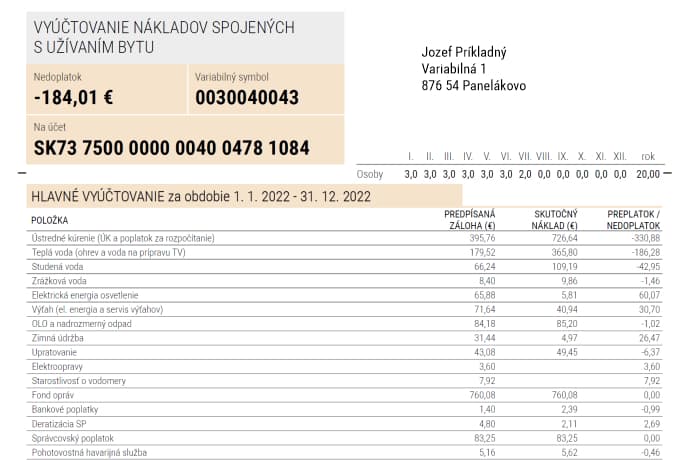
The document is generated either as a letter from the management company or as a separate bill from the service provider. It contains several mandatory sections:
Identification data: your name and address, property address, contract or personal account identifier.
Billing period: usually January 1 — December 31 of the previous year.
Meter readings: readings at the beginning and end of the billing period, actual consumption.
Cost calculation: tariffs, quantity of units consumed, total cost.
Summary table: total of accrued advance payments and actual costs.
Result: the highlighted amount of overpayment or underpayment.
Bank details: for returning overpayments or paying underpayments.
Where to find the overpayment amount
The document usually has a line or table with a summary. Look for the words “Preplatok” (overpayment) or “Nedoplatok” (underpayment) with the corresponding amount.
If the amount is positive and next to “Preplatok,” it is your money to be returned. If it is next to “Nedoplatok,” you need to pay the specified amount.
How to check the accuracy of calculations
Even if you are not very familiar with Slovak documents, there are a few things worth checking:
Meter readings. Compare the numbers in the document with photos you might have taken when you moved in or at the end of the year. If you didn't take photos — it's a good habit for the future.
Billing period. Make sure it corresponds to the time you actually lived there. If you moved in, for example, in April, you are not obliged to pay for the previous months.
Rates. You can check them with the current decisions of ÚRSO or ask the supplier for an explanation. The rates in the document must match the officially approved ones.
Apartment area. The basic cost of heating depends on it. Make sure the correct area is stated in the document.
Number of residents. For some services (water, garbage collection), charges depend on the number of registered or actual residents.
How to get a refund for overpaid utility services
Getting a refund depends on the situation. If you are the owner of the apartment and a direct customer of the supplier or management company, the overpayment is usually returned automatically to the bank account specified in your contract.
If you are a tenant, the landlord has a direct contract with the suppliers, and they receive the overpayment. Then, they are obliged to give it to you. According to Slovak law, a tenant has the right to a refund, and the landlord does not have the right to keep it.
Ways to get your money back
Bankovým prevodom (bank transfer): the most common method. Money is sent to the account specified in the contract or in your application. If your account has changed or you are providing your bank details for the first time, contact the management company or supplier.
Zápočtom na budúce platby (offset against future payments): the overpayment automatically reduces your next advance payments. This is convenient if you continue to live at the same address.
Through the landlord: if you are a tenant, the landlord can return the overpayment as a one-time payment to your account or use it to reduce your next rent payments — as agreed between you.
How long does the refund take
Specific timelines depend on the supplier or management company. For heating and the annual reconciliation from the management company, it is usually within 30–60 days after the document is sent. For gas (SPP) and electricity (ZSE, VSE, SSE), it is usually within 30 days after the annual reconciliation is issued.
If the overpayment is small (a few euros), some suppliers will credit it towards future advance payments without an explicit refund.
You usually do not need to submit an application for a refund if your bank details are known to the supplier and you are a direct customer. However, if your account has changed, or if you are a tenant and the landlord is returning the overpayment, it is advisable to confirm your bank details in writing. Some management companies may require a signed letter or a completed form.
What to do if you don't get your money back
If a reasonable time has passed and the money has not arrived:
Contact the supplier or management company in writing, asking for an explanation for the delay and confirmation of the refund details.
If the supplier or landlord ignores you, write an official written complaint (reklamácia) stating the amount and the deadline.
If the landlord refuses to return the overpayment, you can go to court with a claim for unjust enrichment (§ 451 et seq. of the Civil Code). The court may issue a payment order without a hearing.
If the issue concerns incorrect supplier tariffs, write a complaint to SOI (Slovenská obchodná inšpekcia — Slovak Trade Inspection).
Attention: If the landlord refuses to provide the vyúčtovanie or return the overpayment, it is a violation of your rights. You have the right to demand the documents through the court. We recommend keeping all correspondence with the landlord.
What to do if there is an underpayment
Nedoplatok (underpayment) is the amount you have to pay extra after the annual reconciliation. The payment deadline is usually stated in the document itself: most often it is 14–30 days from the date the reconciliation is issued.
You should not ignore a nedoplatok. The consequences can be:
Accrual of late fees (úroky z omeškania) according to the contract terms or at the legal rate.
Refusal to review advance payments in the future.
For tenants, termination of the lease agreement in case of systematic failure to meet financial obligations.
Transfer of the debt to a collection agency or a lawsuit.
How to reduce future advance payments
If you receive a large overpayment every year, it means your payments are too high. You have the right to apply to the management company or supplier to reduce your monthly advance payments, justifying it with actual consumption data from previous years. The supplier is obliged to consider your application and decide on adjusting the advances according to actual consumption.
Challenging an incorrect annual reconciliation
If you find one of the following situations, your complaint is justified:
The document shows incorrect meter readings.
The applied tariffs are higher than those officially approved by ÚRSO.
The apartment area or number of residents is stated incorrectly.
The billing period includes time when you did not yet live at this address.
The overpayment has not been returned within a reasonable time without explanation.
Where to complain
You can contact the supplier or management company directly with a written reklamácia (complaint). They are obliged to review it within the set deadline (usually 30 days). If the supplier rejects your complaint or ignores it, you can contact the Slovak Trade Inspection (SOI). They handle consumer disputes in the energy and utility sectors. If you suspect that the supplier has applied an unapproved tariff, you can submit a request at urso.gov.sk.
If none of the pre-court options worked and the amount is significant, you can file a lawsuit for the return of unjustly withheld funds.
Deadlines for objections
The deadline for challenging reconciliations is usually 30 days from the date you receive it. Some suppliers state this deadline directly in the document. After the deadline for objections expires, the issued invoice is considered accepted.
Documents:
Copy of the vyúčtovanie.
Your lease or ownership contract.
Photos or videos of the meters (if available).
Correspondence with the landlord or supplier.
Receipts or bank statements for advance payments.
Practical checklist
After receiving the bill, check:
Personal data: Your name, address, contract number, or account number — is everything correct?
Billing period: Does it match the period you actually lived there?
Meter readings: Do they match your records or photos?
Tariffs: Do they match the officially approved ÚRSO rates?
Apartment area: Is the correct area stated (affects heat distribution)?
Result (overpayment/underpayment): Is the amount of preplatok or nedoplatok clearly stated?
Bank account for refund: Is your account number correct (for overpayments)?
Payment/receipt deadline: If there is an underpayment, when does it need to be paid?
Conclusion
Vyúčtovanie is a standard annual procedure in Slovakia, and it affects every resident, whether they own an apartment or rent one. Understanding this document is important: it determines whether you keep your money and know your rights in case of disputes.
The key rules are simple: check the data when you receive the document, keep copies, take photos of the meters at the end of each year, and do not hesitate to ask for explanations — from both the supplier and the landlord. Your rights are protected by Slovak law, and if necessary, you can contact SOI, ÚRSO, or the court.