




Submitting a tax declaration (daňové priznanie) in Slovakia might seem difficult, especially for first-timers. But don't worry – we've broken down the whole process! In this article, you will learn who needs to submit a declaration, when to do it, what documents are needed, how to avoid fines, and even how to get a tax refund. Everything is clear, simple, and stress-free.
Do you need advice or help with filing your tax return?
Leave your request and we can advise you for free and help you with this matter!
What is a tax declaration?
A tax declaration is a report where you declare all your taxable income (zdaniteľné príjmy) for the past year. Based on this document, the tax office (Finančná správa) calculates your income tax (daň z príjmov). If you paid more than you owe, you will get the excess back (daňový preplatok). If you owe more tax, you will have to pay the difference. The most important thing is to submit the declaration correctly and on time to avoid fines or audits.
Who needs to submit a declaration?
Not everyone needs to submit a declaration themselves. Here are the main categories that must do so:
Natural persons: Your annual income exceeded €2,823.24 (this includes your salary for the year, as well as other taxable income: income from renting out property, selling assets, dividends, royalties, etc.).
Legal entities: All companies, except for civic associations (občianske združenia) or budget organizations (rozpočtové organizácie) with non-taxable income, are required to submit a declaration.
Self-employed persons (SZČO): For example, sole traders (živnostníci), licensed lawyers, or other individuals running their own businesses.
Persons with income from abroad: If you received money from other countries, you must declare it too.
Those working multiple jobs: If you have a main job and a side job, or if you combine several sources of income.
Exception: If you only work one job under an employment contract and have your annual tax reconciliation (ročné zúčtovanie) done by February 17, your employer will submit the declaration for you, and you don't need to do anything. Annual tax reconciliation is when your employer checks your income and taxes for the year. They usually inform you when and how to request it, for example, by submitting an application to the accounting department.
⭐️ If you need detailed advice or help from an accountant – write to us on Telegram – we will recommend trusted specialists to save you time and stress.
How to submit a declaration: a step-by-step plan
The process of submitting a declaration is not that complicated if you understand it in advance. Here's what you need to do:
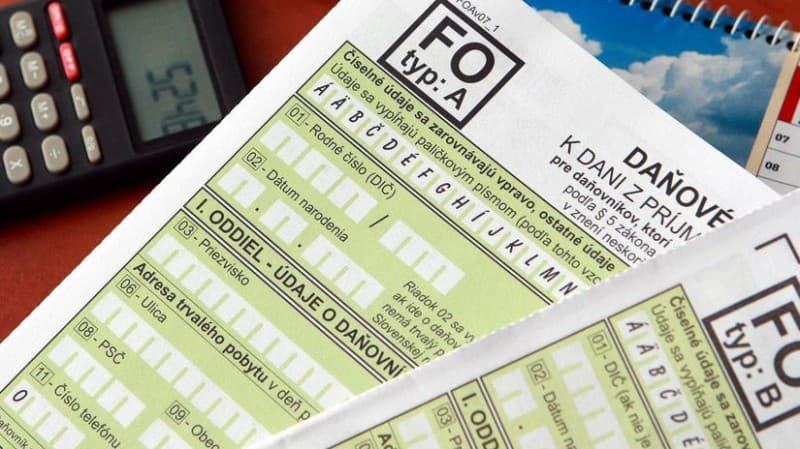
Step 1. Choose the correct form
For natural persons, there are two main types of declarations:
Type A: For those who only had income from salary (príjmy zo závislej činnosti). This form is simpler and has 6 pages.
Type B: For self-employed persons (SZČO), individuals with income from business, rent, capital, or other sources. This form is more complex, with 13 pages and 4 attachments.
Legal entities use a single form specific to companies. All necessary forms for the tax declaration are available on the official website of financnasprava.sk in the section "Katalóg elektronických formulárov". This section contains forms for both natural and legal persons, including Type A and Type B declarations, applications for deadline extension (Oznámenie o predĺžení lehoty), and other forms. To find the required form, select the area "Správa daní", then the agenda "Daň z príjmov fyzickej osoby" or "Daň z príjmov právnickej osoby", and specify the form name. The website allows you to download the form, fill it out online with basic validation checks, save it as XML, print it, or sign it with an electronic signature (KEP) for submission. The forms do not contain pre-filled data but have a user-friendly interface for entering information.
Step 2. Prepare your documents
Do you need advice or help with filing your tax return?
Leave your request and we can advise you for free and help you with this matter!
To fill out the declaration without errors, gather all necessary documents in advance.
Income statements (potvrdenia o príjmoch): These are official documents from all employers or other sources of income for the year, including foreign ones. For example, if you worked under an employment contract, your employer will issue a statement of your salary and taxes paid. For income from abroad, you will need similar documents from the foreign employer.
Documents for tax reliefs: Tax reliefs allow you to reduce your tax or receive payments if you meet the conditions. For this, you need supporting documents:
Child tax bonus (daňový bonus): Available for parents or guardians of children under 18 years old (or up to 25 if they are studying). In the declaration (Type A: Section XI, Type B: Section XIV), enter the child's details: name, date of birth, period of residence. Attach copies of birth certificates, adoption decrees, or guardianship documents.
If the child is over 16 and studying abroad, a school attendance certificate is required (not needed for Slovak schools if the child lives with you). The tax office will pay the bonus to your account or reduce your tax.
If these documents were submitted previously and the details have not changed, you do not need to provide them again.
Mortgage interest bonus (daňový bonus na zaplatené úroky): For those paying a mortgage on a home where they live. In the declaration (Type A: Section XI, Type B: Section XIV), enter the amount of interest paid during the year.
Attach a certificate from the bank (potvrdenie od veriteľa) that complies with Law No. 90/2016 (for contracts before December 31, 2023) or Law No. 508/2023 (for new contracts). If necessary, attach a copy of the mortgage agreement. The tax office will refund part of the interest or reduce your tax.
Documents for volunteer activities: If you want to donate 3% of your paid tax to charity (instead of the standard 2%), you need a written confirmation of at least 40 hours of volunteer work during the year. This document is attached to the declaration as proof of your participation.
Documents for self-employed persons (SZČO): If you work as a sole trader (živnostník) or have another type of self-employment, prepare documents confirming your business income. Also, attach statements of paid insurance contributions to the social security (Sociálna poisťovňa) and health insurance (zdravotná poisťovňa) funds for the year, as these contributions reduce your tax base. If you keep accounting records, attach a report of income and expenses (e.g., kniha príjmov a výdavkov).
Tip: Gather all documents in advance and check if they meet the requirements to avoid delays or denial of bonuses. If you are unsure, consult an accountant.
Step 3. Fill out and submit the declaration
You can fill out the form in several ways:
Electronically: Through the Finančná správa portal, which is the main resource for interacting with the Slovak tax office. You will need a qualified electronic signature (KEP). This is mandatory for VAT payers and companies registered in the commercial register.
By print: Fill out the form by hand, print it, and submit it by mail or in person at the tax office (daňový úrad).
Step 4. Meet the deadlines
Main deadline: March 31, 202X.
Extension: You can submit an application for an extension (sample) by June 30, 202X, or by September 30, 202X, if you have income from abroad (príjmy zo zahraničia).
Important: If you miss the deadline, the tax office may charge a fine. Submitting a tax declaration in Slovakia is a manageable process if you know the basic steps. Determine if you need to submit a declaration, choose the correct form, prepare your documents, and don't miss the deadlines. Although you can fill out the declaration yourself, mistakes can lead to fines or loss of bonuses. A professional accountant can help you:
Choose the correct form and fill it out properly.
Consider all possible reliefs and bonuses.
Submit the declaration on time, especially if you have complex income (e.g., income from abroad or from business).
Average prices for services: €50 for natural persons (Type A), €70–€100 (Type B), €220 for legal entities.
Do you need advice or help with filing your tax return?
Leave your request and we can advise you for free and help you with this matter!